The CHIRP (Children with IncarceRated Parents) study
May 1, 2026
About
This study is the first in Canada to systematically estimate how many children experience parental incarceration.
Parental incarceration has significant negative effects on children’s mental and physical health. Yet credible data on how many children are affected has been lacking, which has hindered policy development and public support for these children. This study aimed to help fill that gap. It provides minimum estimates of the number of affected children in five Canadian provinces between 2015 and 2021, and describes the characteristics of affected parents and children.
The project was co-developed with community stakeholders, who helped conduct the study, share and apply its findings, and shape future research and policy work.
This study makes clear that action is needed to prevent parental incarceration and to better support the children and families it affects.
Principal Investigators
- Fiona Kouyoumdjian, Associate Professor, Family Medicine, McMaster University
- Martha Paynter, Associate Professor, Faculty of Nursing, University of New Brunswick
CHPC Co-Investigator
- Nicole L.A. Catherine
Research Team
Click/tap to see the full list of team members
- Co-Principal Investigators: Kouyoumdjian, F. (McMaster University), Paynter, M.
- Co-Investigators: Bondy, S.J., Butler, A., Catherine, N., Cavanagh, A., Coyle, E., Liauw, J., Tessier, S., Wang, C., Robinson, P., Irving, M., Russell, N.
Funders
Funding
- $74,988 (over one year)
Key Findings
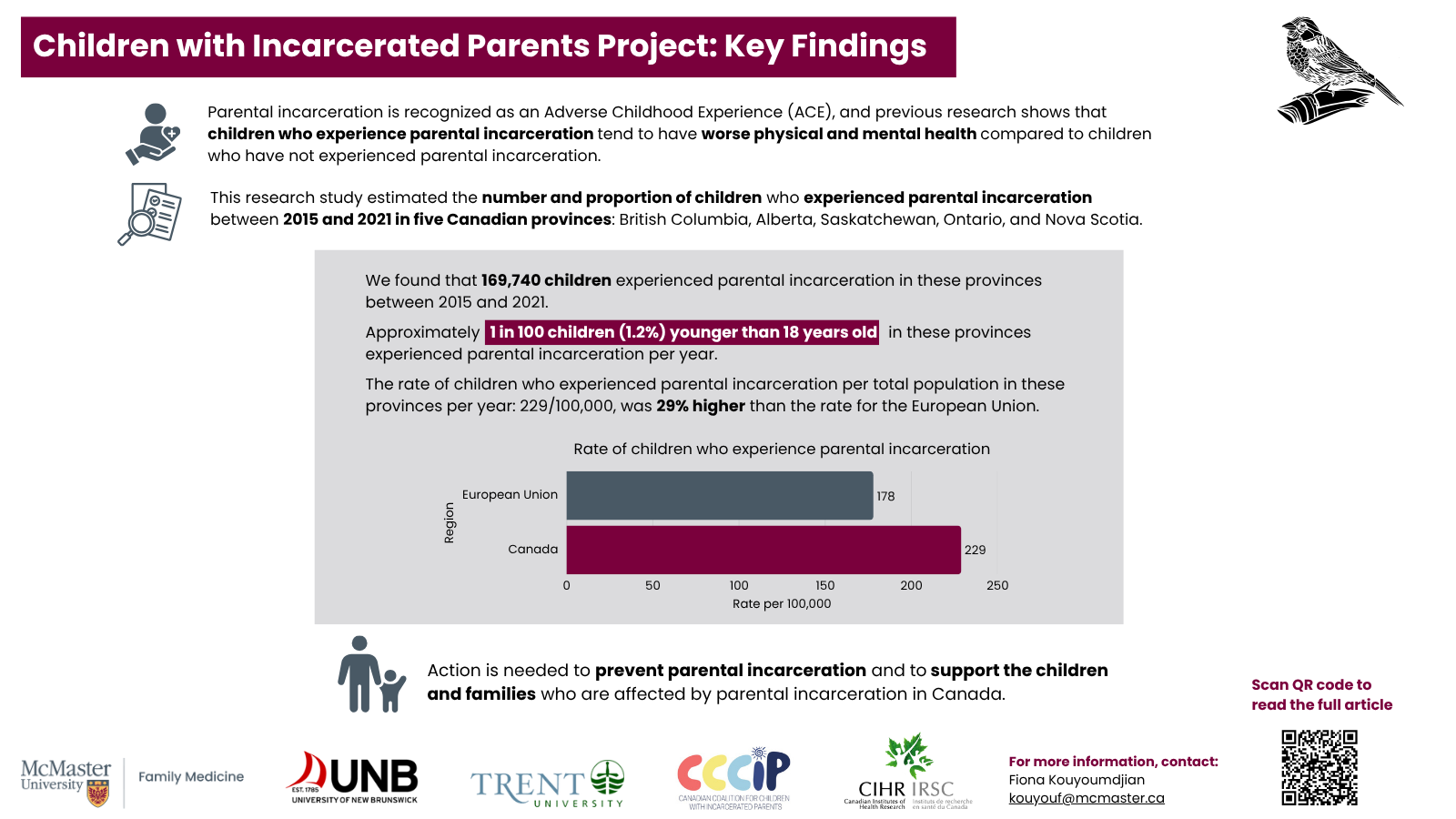
- 169,740 children experienced parental incarceration across British Columbia, Alberta, Saskatchewan, Ontario and Nova Scotia between 2015 and 2021.
- Approximately 1 in 100 children (1.2%) younger than 18 years old in these provinces experienced parental incarceration per year.
- The rate of children who experienced parental incarceration per total population in these provinces per year (229/100,000) was 29% higher than the rate for the European Union.
- Reflecting existing systemic inequities, parental incarceration had a disproportionate impact on Indigenous and Black children. Among the children included in the study, 5% had at least one Indigenous parent and 5.9% had at least one Black parent.
- Most children experienced more than one episode of parental incarceration, and 25% experienced four or more episodes.
What This Means
- Understanding how many kids are affected: This research provides a baseline for measuring how many children in Canada experience parental incarceration.
- Raising awareness: These findings can help increase awareness of the prevalence and impact of parental incarceration among policymakers, the media, and the public.
- Shaping prevention and support: This community partnership generated data that policymakers and communities can use to help prevent parental incarceration and better support affected children and families.
Publications
- Kouyoumdjian F.G., Paynter M., Knudsen E.M., Croxford R., Bondy S.J., Jennings L., Russel N., Semeniuk R., Bentley-Wang C., Butler, A., Butsang T., Catherine N.L.A., … & Sharma S. (2026) Estimating the number and percentage of children who experience parental incarceration in Canada using whole population administrative and vital statistics data. PLoS One 21(4): e0344941. https://doi.org/10.1371/journal.pone.034494