
Helping policy makers respond to the needs of kids

A recent video conference, focusing on an academic publication by the Children’s Health Policy Centre, ended up highlighting a unique partnership in B.C.

“I think it’s remarkable that you have such an integrated group of people who implement policy, who advocate for policy and who research policy,” said moderator Michael Ostacher, associate professor of psychiatry and behavioural sciences at Stanford University and digital content editor for the journal Evidence-Based Mental Health.

The one-hour discussion brought together the BC Ministry of Children and Family Development, represented by Rob Lampard, the BC division of the Canadian Mental Health Association, represented by Bev Gutray and the CHPC research team, led by Charlotte Waddell. She was joined by Christine Schwartz and Jen Barican from the CHPC.

Although the impetus for the event was publication of a systematic review of prevention and treatment of childhood behaviour disorders, the wide-ranging discussion touched on much broader issues and concerns.

Highlighted was the unique relationship between the CHPC research group and the BC government. “There’s been a relationship between [the CHPC and] the policy branch that goes way back to the early 2000s,” said BC Child and Youth Mental Health Policy Executive Director Rob Lampard. “The team has had a big influence on the public policy landscape. Their excellent work is part of a large fabric that’s been woven over many years.”

His positive views were echoed by BC division Canadian Mental Health Association CEO Bev Gutray. “It’s a great privilege to be part of this team,” she said, noting that she was particularly happy with her own group’s ability to launch an intervention called Confident Parents/Thriving Kids. An adaptation of evidence-based parent training developed in Oregon, the built-in-BC program is able to provide support to parents via the phone in evenings and on weekends. “We couldn’t have done this without the CHPC team,” Gutray said. “And the Ministry has been alongside us every step of the way,” she adds.

While emphasizing the value of systematic review work, CHPC director Charlotte Waddell also stressed the importance of being pragmatic. “It’s really important to avoid what some people have called systemic review nihilism,” she said. “We need to give policy makers something practical that will allow them to respond to kids’ needs.”

Anyone wishing to view the video conference can see it here.
Hangout addresses childhood behaviour disorders

You are invited to attend a Google Hangout on preventing and treating childhood behaviour disorders, Sept. 5 at 8 am Pacific time.

Attending the event will be a team of people from the Children’s Health Policy Centre, including the director and child psychiatrist, Charlotte Waddell, clinical psychologist and scientific writer Christine Schwartz and research manager Jen Barican. The CHPC has authored a publication for the journal Evidence-Based Mental Health, which is the organizer of the hangout.

Also attending the event will be representatives of the Canadian Mental Health Association, the BC government, Oxford University and Stanford University.

Oppositional defiant and conduct disorders start early and persist, incurring high individual and collective costs. The panel of experts will discuss the best available research evidence on preventing and treating these disorders, following their recent systematic review. The review will provide a starting point for wide ranging discussion and debate, including consideration of the implications of the evidence for policy and practice.

To join the event go to YouTube at https://bit.ly/2wmos51.

Children’s Health Policy Centre team takes children’s mental health messages to Banff

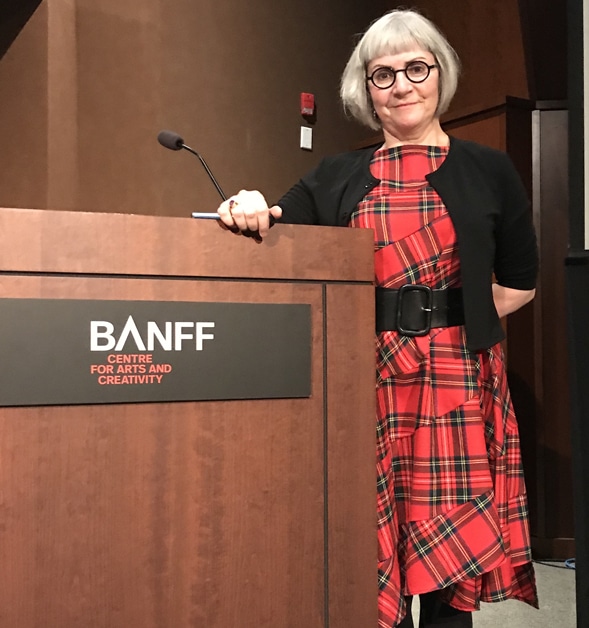
Representatives from the Children’s Health Policy Centre were proud to address the 50th Annual Banff International Conference on Behavioural Science, March 18 to 21, 2018. The theme was, “What are Ideal Children’s Mental Health Services?”

CHPC director Charlotte Waddell (adjacent), delivered the closing plenary address on the topic, “Improving Children’s Mental Health: The Policy Opportunities in Canada.” In her 50-minute presentation, Waddell covered a host of topics for the broad-ranging audience that included everyone from well-known academics to graduate students.

Waddell’s key messages included five points:

• It’s important not to focus on one age group at the expense of others. The responsibility facing children’s mental health policymakers encompasses all young people from before birth to early adulthood.

• There are considerable challenges in providing services for all ages and all disorders. “We are currently reaching only 30% of children with mental health disorders,” Waddell said, citing a recent systematic review the CHPC prepared.

• We shouldn’t fall for the argument that there’s not enough money. “Canada spends a lot on healthcare, but if we look at current Canadian spending, most of it is going towards older Canadians,” Waddell said. “We need to have a public conversation about that.”

• It is possible to change spending patterns. This has been demonstrated by spending on autism where funding has increased tenfold over the last 10 years. “It’s a terrific success story for one mental disorder,” Waddell says, adding, “We can learn from that.”

• We need to triple spending on children’s mental health. “That goal is entirely reasonable,” according to Waddell. She adds that new spending should cover both prevention and treatment, and should go towards effective or proven interventions.

Earlier in the conference, the CHPC team also delivered a three-hour workshop titled, “Research-policy partnerships in children’s mental health: Lessons from British Columbia.” In it, Nicole Catherine spoke about her experience as Scientific Director and Co-Principal Investigator of the BC Healthy Connections Project, the first Canadian randomized controlled trial evaluating the Nurse-Family Partnership (NFP) program.

Developed nearly 40 years ago by David Olds and colleagues in the US, NFP starts in early pregnancy, before children are born, and involves intensive home visits continuing until children reach their second birthday. The program particularly focuses on girls and young women and their children who are facing disadvantages such as low income.

The BC Healthy Connections Project trial involves close collaborations with BC policymakers in the Ministries of Health and Children and Family Development and in four participating regional Health Authorities. Some 744 children are being reached through the trial, with final results expected in 2020–2021.

In the same workshop, Christine Schwartz spoke about the Children’s Mental Health Research Quarterly, describing a longstanding research-policy-practice partnership with BC’s Ministry of Children and Family Development. She highlighted the methods used to convey research evidence to policymakers, as well as to practitioners and families.

These methods include preparing systematic reviews of evidence on prevention and treatment interventions across a wide array of childhood mental health problems. Evidence is then prepared in user-friendly formats, published free on line, in the Quarterly. Topics are chosen in consultation with policy partners and each issue is accompanied by talks.

BC children need more funding for mental health

The BC child and youth mental health budget should be tripled to ensure help for the estimated 70 per cent of young people with mental disorders who currently receive no effective treatment, according to Charlotte Waddell, director of SFU’s Children’s Health Policy Centre.

Waddell shared her views in an article published recently in the Vancouver Sun.

The system needs more interdisciplinary teams, including psychologists, nurses and social workers, to be available in communities where children live, according to Waddell. But instead, budgets for these services, which are provided for all BC children through the Ministry of Children and Family Development’s Child and Youth Mental Health Branch, have been steadily eroded over the years.

Waddell also said that some common childhood disorders — such as anxiety, behaviour problems, substance misuse and depression — could be avoided if society invested in more preventive programs. There are many such programs that are effective and that can be delivered, in family homes and in schools. (For examples, please see the Centre’s recent publication on preventing childhood depression as well as one on preventing anxiety in children.)

Waddell noted that budgets for autism in both B.C. and Ontario have increased 10-fold over the last decade, mostly due to effective lobbying by parents of autistic children. The same has not been true for budgets for other childhood mental disorders, she said. But these increases for children with autism show that increases are possible.

The story, which ran under the headline “Not enough services for mentally ill kids, says family of struggling boy,” was published in the Dec. 1/17 issue of the Vancouver Sun. A follow-up story appeared on Dec. 4/17 under the headline, ” A mother’s plea: Save unique Richmond school that helped her 7-year-old mentally ill son.”

Many happy returns: All babies are delivered


Consider this an unusually weighty birth announcement.

All the babies have now been born to the young mothers enrolled in the BC Healthy Connections Project (BCHCP). There are 744 young ones, including 11 sets of twins.

“People are usually happy to hear birth announcements, but this one is particularly exciting,” says Charlotte Waddell, one of the project leads. “We believe this project will give these mothers and these children a stronger voice.”

The BCHCP is the first Canadian scientific evaluation of the Nurse-Family Partnership (NFP) program. NFP aims to help young first-time mothers and their children by providing intensive visits by specially-trained public health nurses. The goals are to improve children’s health and development, while also improving the mothers’ lives.

The success of the program has been widely documented in the US, most recently in a study released July 24/17 by James Heckman, a Nobel laureate economist at the University of Chicago. By ages six and 12, children whose mothers received the home visits were healthier and had better cognitive and social and emotional skills, he found. And mothers had better mental health and parenting skills, he added. A US National Public Radio interview with Heckman spells out why he believes NFP has been so successful in the US.

The BC evaluation is using randomized controlled trial methods to investigate how NFP compares with the province’s existing health and social services. Preliminary profiles of the participants will be released later in 2017 with main study results to follow after all the families have graduated in late 2020. An outline of the project may be seen here, along with a journal article on the study protocol.

There are also two adjunctive studies associated with the BCHCP. The first is a Process Evaluation, determining how well the intervention is being implemented and what factors may be influencing its outcomes. The second is the Healthy Foundations Study, examining biological markers of health outcomes for children over the first two years of life.

BC leads the country by being the first province to now offer Nurse-Family Partnership to all eligible women who are interested. Five regional Health Authorities — Fraser, Interior, Island, Northern Health and Vancouver Coastal Health — have opened the program with no need for randomization to control and intervention groups.

To enquire about Nurse-Family Partnership or to enroll in the program, please contact:

  1. Your nurse practitioner, family doctor or midwife, or
  2. Your local Health Authority:

Recruitment closed for BC Healthy Connections Project

Here is a progress update on the BC Healthy Connections Project — a scientific evaluation of the Nurse-Family Partnership (NFP).

We closed recruitment in the randomized controlled trial (RCT) last December with 739 families enrolled across four of the five participating regional Health Authorities: 406 from Fraser Health; 84 from Vancouver Coastal Health; 122 from Interior Health; and 127 from Island Health. To date, more than 700 babies have been born to participants, including 11 sets of twins. The BCHCP is continuing with data collection on all women and children until the end of 2019.

Across these four Health Authorities, 215 children and women have now graduated from the study. We’re staying in touch with families after they graduate — to invite them to participate in future follow-up studies, for example, to see how children are doing when they reach kindergarten. Preliminary papers will be released later in 2017 with main study findings to follow after all the families have graduated later in 2020.

NFP is a home visiting program providing intensive supports to young women who are living on low income and preparing to parent for the first time. This innovative public health program is delivered over two-and-a-half years, beginning prenatally and continuing until children reach their second birthday. It aims to improve children’s mental health and development while also improving mothers’ life circumstances.

This evaluation of NFP is the first in Canada and is being led by the Children’s Health Policy Centre at SFU. We are doing this together with scientific collaborators at McMaster University, UBC and the University of Victoria. The project is also being conducted in close collaboration with policy partners in the BC Ministry of Health and the BC Ministry of Children and Family Development — and in Fraser, Vancouver Coastal, Island, Interior and Northern Health Authorities.

As well as the RCT, the BC Healthy Connections Project includes two adjunctive studies, both federally funded. One is a nursing Process Evaluation, which aims to learn how Nurse-Family Partnership can best be adapted for use in BC. It is being conducted in all five participating regional Health Authorities. The other is the Healthy Foundations Study, which is assessing biological markers of stress in children who are receiving NFP, versus those who are not. It is being conducted in Fraser and Vancouver Coastal Health Authorities. Results for Process Evaluation are being released on an ongoing basis, while preliminary Healthy Foundations reports are expected in early 2018.

With study recruitment closed, (and BCHCP data collection ongoing), BC leads the country by being the first province to now be offering Nurse-Family Partnership to all eligible women who are interested. In parallel to the BCHCP, all regional Health Authorities have opened the program to everyone, with no need for randomization to control and intervention groups.

To make or receive a referral to Nurse-Family Partnership please contact:

  1. Your nurse practitioner, family doctor or midwife, or
  2. Your local Health Authority:


BC recommits to Nurse-Family Partnership

BC has recently released a new Mental Health Strategy (2017–2020). This is a supplement to Healthy Minds, Healthy People, BC’s existing 10-Year Mental Health Plan (2010–2020) jointly sponsored by the BC Ministries of Health and Children and Family Development.

Of note, the new plan recommits to supporting Nurse-Family Partnership. This intensive public health nursing program supports young, first-time mothers and their children who are living on low-income. Starting prenatally then continuing over the first two years of the child’s life, the program aims to improve children’s mental health and development, while also improving the mother’s life circumstances.

Nurse-Family Partnership is currently undergoing a scientific evaluation known as the BC Healthy Connections Project. The Children’s Health Policy Centre at SFU is leading this randomized controlled trial with more than 700 families — with scientific collaborators at McMaster University, UBC and the University of Victoria. The Project is also being conducted in close collaboration with policy partners in the BC Ministry of Health and the BC Ministry of Children and Family Development, as well as in Fraser, Vancouver Coastal, Island and Interior Health Authorities.

In other news, the plan will also increase the number of community-based child and youth mental health clinicians across the province. It will add up to 120 net new positions to existing services over three years. This will increase access for up to 7,000 children and youth each year on top of the 27,000 who are currently being served.

The new staff will include specialized clinical practitioners, and community support and outreach workers. They will help Indigenous and non-Indigenous children and youth and their families address their mental-health challenges.

Anyone seeking a referral to Nurse-Family Partnership should contact their local Health Authority.

Anyone seeking more information on Child and Youth Mental Health services should contact the Ministry of Children and Family Development.

Study milestone reached

BC Healthy Connections recruitment closing as planned

Recruitment into the randomized controlled trial known as the BC Healthy Connections Project (BCHCP) closed on Dec. 16.

This recruitment — which started three years ago, in October 2013 — stood at 739 families at time of closure, a sample size large enough to estimate the effects of the Nurse-Family Partnership (NFP) program in BC. Some 100 of these families have already completed the research study.

With NFP, public health nurses visit young women who are pregnant and preparing to parent for the first time. Aimed at mothers whose circumstances place them at risk for vulnerability, the program provides them with home visits and intensive supports until their child’s second birthday. NFP starts very early in life — prenatally — allowing it to influence child development right from the start.

“We’re very proud to be reaching this study milestone,” says Scientific Director, Nicole Catherine. Her feeling is echoed by another study lead, Charlotte Waddell, who emphasizes the teamwork involved. “This has been an enormous team effort — involving the Ministries of Health and Children and Family Development, and nurses and communities and Health Authorities across this province,” she says.

The Children’s Health Policy Centre (CHPC) at Simon Fraser University is leading this scientific evaluation — with others from across BC and Canada. Collaborators include researchers at McMaster University, the University of BC, the University of Victoria and the Public Health Agency of Canada. (The BC Ministry of Health is funding the project, with support from the BC Ministry of Children and Family Development, as well as from regional Health Authorities.)

The CHPC study team is following each of the 739 families until they all finish a series of interviews. The team has conducted more than 2,500 research interviews with families to date. More than 600 babies have already been born to participating families, including eight sets of twins.

Scientific Director Catherine says that while scientific rigour is at the heart of this project, the CHPC study team has remained strongly committed to the human side of the undertaking. “Our commitment and our frequent contacts have led to some strong connections between the scientific field interviewers and the mothers,” she says. “We’re learning from new mothers and watching the children grow while we are conducting the research interviews.”

The CHPC study team is collecting and analyzing a wide array of child and maternal health information with a special focus on issues relating to child development, as well as mothers’ wellbeing. Young mothers say they enjoy being part of the project because they feel that their voices are being heard — often for the first time.

Following the closure of recruitment, research data collection and participant tracking will continue until all the children in the study reach two years of age. The team is also obtaining consent to remain in contact with all the families — to lay the foundation for longer-term child follow up over the preschool years and beyond.

Beyond evaluating how NFP works in BC, the BC Healthy Connections Project will also provide new information on young mothers who are coping with disadvantages such as living on low income, or struggling to find secure housing. This is a population that has often been underserved. So as a first step to help, the CHPC study team is aiming to provide initial reports by mid-2017. These reports will provide descriptive characteristics on study participants, including information on social determinants of health, as well as service access and use during pregnancy. The results on how well NFP works will follow once data collection closes.

According to BC’s longstanding intentions, regional Health Authorities will begin offering NFP to all eligible women — as a program embedded within other public health services — starting Dec. 17. The regional Health Authorities, together with the BC Ministry of Heath, are responsible for all aspects of planning and implementing the ongoing delivery of NFP as a provincial program from here.

Meanwhile, the BC Healthy Connections Project research team will continue collecting and analyzing data. When all 739 families have completed the study, in just over two-and-a-half-years from now, information on NFP’s effectiveness will be used to further improve BC’s child and maternal public health programs.

More information on the BC Healthy Connections Project is available here. More information on NFP open enrollment, is available here.